Hours Today: 05/22/13
8 am-8 pm | see all hours
Ask a Librarian
Bailey/Howe Library has changed closing hours for Monday-Thursday during the summer session (May 20-August 9). The new closing time for Monday-Thursday is 8 p.m. Below is a snap-shot of the hours for Bailey-Howe Library this summer.
Summer Session, May 20-August 9
Monday-Thursday…………….8 am-8 pm
Friday…………………….8 am-5 pm
Saturday…………………..Noon-5 pm
Sunday…………………….CLOSED
The Lauren Pomeroy postcard album in the University Archives provides a glimpse of student life at UVM from 1908-1910.
Please check out this video about our new group study rooms:
Thanks to Philip Cheney, Aubry Norman, and Coco Zephir for putting this video together.
Porch Life: An Exhibit from the Louis McAllister Photograph Collection
Special Collections Reading Room, Bailey/Howe Library
With thousands of pictures of buildings and people, the McAllister Photograph Collection contains many images of porches of all sorts in northwestern Vermont. Inspired by UVM professor Thomas Visser’s book, Porches of North America, this exhibit includes photographs of people relaxing, socializing and meeting on porches, porch furnishings, and “porch portraits”–portraits of individuals, families and groups gathered on porches.
Free and open to the public.
April 23, 2013, 7 pm, Special Collections Reading Room, Bailey/Howe Library, UVM
Thomas Visser, associate professor of Historic Preservation and director of the Historic Preservation at the University of Vermont, will discuss his latest book, Porches of North America. His slide presentation will explore how this well-loved building feature has evolved in the United States and Canada. He will also discuss his research into many curious social uses, traditions, customs, and special activities associated with porch life.
While porches have a long history and are a familiar feature of the landscape, Visser and his students discovered that there were relatively few real studies of porches. He has filled the gap with Porches of North America, a 304-page book that includes sections on the history of porches as well as their many forms and functions. The book is loaded with illustrations of porches of all kinds, many from UVM Special Collections. For a preview, check out this short video.
The presentation is free and open to the public. For more information, email uvmsc@uvm.edu or call 656-2138.
Please take our library user survey now by selecting your most frequently-used library:
Bailey/Howe Library
Dana Medical Library
The University Libraries care about what you think. We want your voice to be at the heart of our planning efforts.
Every four years we run a very important, nationally-benchmarked electronic survey that helps us learn how our user community views library services, collections, and facilities.
Help us raise up to $2,000 for the Chittenden County Emergency Food Shelf by participating in this year’s survey. We’ll donate 50 cents for every response until we reach our goal. It takes approximately ten minutes to complete the survey – in that time you’ll be providing multiple meals to a hungry neighbor. Additionally, participants can enter a drawing for gift certificates to UVM’s bookstore.
Your responses will be held in confidence. No identifying links between responses and the individual responding will be retained. The survey is called LibQUAL+ (TM) and is administered by the Association of Research Libraries. If you have any difficulty in accessing or taking the survey, please contact Selene Colburn at Selene.Colburn@uvm.edu.
The Center for Digital Initiatives has launched its first collection of Vermont maps, “Historical Maps of Burlington and Winooski.” Ten of the most frequently used maps in Special Collections are now available online.
The collection contains wall maps, city plans, and atlas sheets published between 1830-1890, a period when Burlington became the largest city in Vermont and a center of commerce and industry on Lake Champlain. The earlier maps show the village and rural sections of the town of Burlington, which extended from Lake Champlain on the east to Muddy Brook on the west, and from the Winooski River on the north and the town of Shelburne on the south. Later maps cover the City of Burlington, which was established in 1865 when most of the rural areas were set off to create the town of South Burlington. Maps of the neighboring village of Winooski are also included in the collection.
The maps show streets, buildings and lots, building owners’ names and functions, parks, cemeteries, wards, railroads, and some natural features. Some of the maps include illustrations of prominent buildings and business directories.
A zoom function makes it possible to extract detailed information, such as the horse racing track at Howard Park in the southern part of town on the 1890 map of Burlington.
The University of Vermont as shown on one of the 1869 maps.
A section of the business directory on the 1869 map of Winooski Falls.

B/H’s Interlibrary Loan Department announces that two e-readers are available for use by patrons seeking access to electronic documents that otherwise are unavailable. Patrons using this service will receive an e-reader preloaded with their requested information. The lending period is two weeks. Click here to make a lending request.
Lecture: March 14, 5:30 pm, Special Collections Reading Room, Bailey/Howe Library
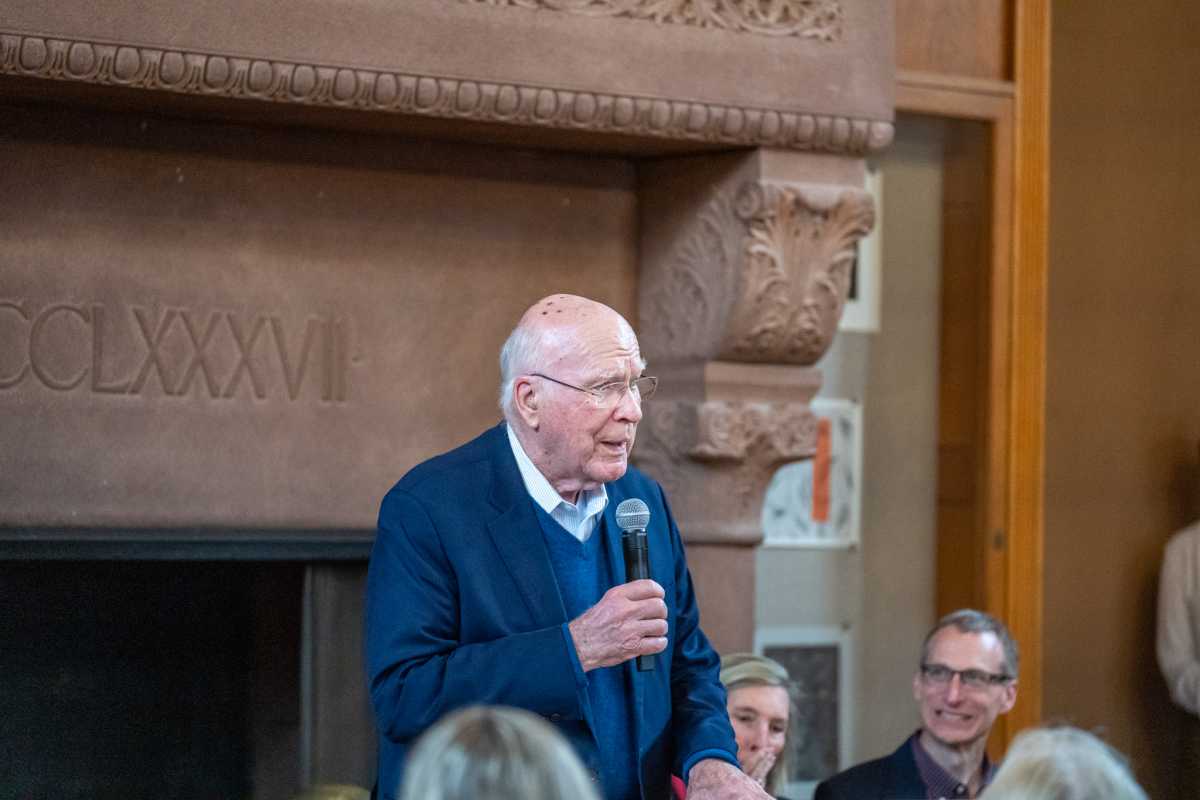
University of Vermont professor Harvey Amani Whitfield will discuss the tensions between slavery and freedom in early Vermont history. His research indicates that the end of slavery in Vermont was messy, disorderly, and contradictory and that various forms of bondage persisted in Vermont well after the 1777 abolition of adult slavery.
Professor Whitfield’s areas of research are the black population in the Maritime colonies and Vermont. In 2006, he published Blacks on the Border: The Black Refugees in British North America, 1815-1860. His article, “African Americans in Burlington, Vermont, 1880-1900,” was published in Vermont History in 2007.
The presentation is free and open to the public. For more information, email uvmsc@uvm.edu or call 656-2138.